Be Back Soon
Thanks for checking in. We’ll be back to normal next month.

In 1974, Leonard Cohen hired producer John Lissauer to help him create the new sound for his songs. Moving away from the heavily reverberating, simplistic arrangements of Songs of Love and Hate (1971), Cohen uses large vocal ensembles, banjos, jews harp, heavy percussion, strings, and woodwinds to create a palate that is, in my opinion, finally equal to the depth of the writing itself.
The album opens with one of my favorite Cohen songs, “Is This What You Wanted.” The record is probably worth its weight in gold for the horn arrangements alone during the first verse (listen, kids, right channel). Once the chorus kicks, with the broken, funky backbeat and the monotone call and response chorus, you know you have stumbled upon something brilliant. Although Rolling Stone called this record “not one of his best,” I feel that it must be considered a classic. Coming in at track 2 is the controversial, beautiful, sex charged new york anthem, Chelsea Hotel #2. One of the few songs Cohen co-wrote, this track details the alleged sexual encounter between our Hero and the one and only Janis Joplin. Songs like “There is a War” bring out the louder, more politically charged side of this artist. While “Who by Fire” is a stunningly beautiful octave charged and simplistic male/female duet which borrows from traditional jewish prayer to ask the question of how will we all die.
Still want to listen? Good. Me too. Full of good funky 70’s folk-rock production with a knack for the depressed and the overly beautiful, this record sings about all the necessary topics you need to get you through the end of march and bursting into the spring. Also, the cover art is so awesome that Columbia refused to press it on the first release of the record. And if Angels want to screw to this music, it can’t be half bad.
“Is This What You Wanted”
CD Reissue | 1995 | Sony | mp3 Download | Buy from Amazon
]
Original Vinyl | 1974 | Columbia | search ebay ]

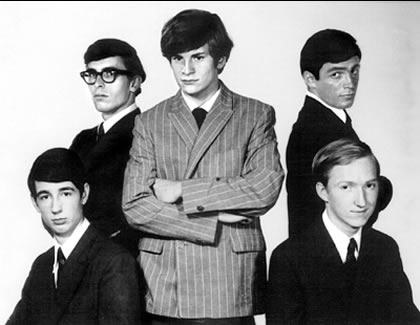
The Blue Things were a great band from the Midwest. They had a Beau Brummels Volume 2/From The Vaults sound crossed with some Gene Clark era Byrds. While they were extremely popular in the Midwest, the Blue Things never reached fame at a national level despite a great folk-rock album and some groundbreaking early psychedelic singles.
The band started out releasing singles on independent (private) labels around 1964/65 with a strong Searchers/early Beatles flavor. Some of these singles such as Pretty Things-Oh! were very strong and deserved more attention. Eventually they evolved into a tight folk-rock band that strongly recalled Help/Rubber Soul era Beatles.
Val Stocklein wrote most of the compositions and his vocals are a world weary mixture of Gene Clark and Help era John Lennon. They released their only self-titled album (commonly referred to as Listen & See) in 1966 and by this time, the band had already been experimenting with a psychedelic sound. The album is one of folk-rock’s highlights. A singled released from the album, Doll House/Man On The Street was spectacular. Both songs dealt with subjects uncommon for rock in that era (or any era), prostitution and social injustice.They are both characterized by glittering guitars, thoughtful lyrics, great harmonies, tambourine and a driving beat. There is no doubt that this was one of the defining moments of the folk-rock revolution. Other album tracks highlighted the group’s influences. Honor The Hearse was very Dylan-like but still effective while High Life, I Must Be Doing Something Wrong, It Ain’t No Big Thing Babe and Now’s The Time were also really strong, classy folk-rockers.
There were a few raw covers of old rock standards as well, that recalled their club and bar days. Ain’t That Lovin’ You Babe is particularly noteworthy for a blistering guitar solo. Desert Wind, an outtake from this era, is another great melancholy folk-rock winner. The Blue Things would eventually release two classic psychedelic singles before Val Stocklein left, effectively putting an end to the original group. Orange Rooftops Of Your Mind was their creative zenith, an explosion of sound, featuring violin-like fuzz guitar tones, echoed vocals, a great folk-rock bridge and an organ rave up. The B-side, One Hour Cleaners, was almost as good, with some strange lyrics and a good beat. This single was released in 1966 just when psychedelia was beginning and may have been the first genuine Midwest acid-rock single. You Can Live In Our Tree, another good A-side paired with a great psych version of Twist and Shout was more of the same.
The inability to sell records or become commercially viable frustrated the group and left them bitter. One more single was released in 1967 after Val’s departure and without his involvement. Yes My Friend paired with Somebody Help Me did not recall the band’s heyday in any way and was actually pretty weak. The Blue Things soldiered on for a while playing live but eventually decided to call it a day before the end of the decade.
“Doll House”
2CD Reissue | 2008 | Cicadelic | Buy @ Cicadelic Records ]
reposted from March, 2007. Check out the brand new 65-song reissue.

The Insect Trust’s only two albums are a great example of what today would be called wyrd America. Back then, such terms did not exist and even still, it’s unfair to label this individualistic band.
They were often compared to San Fransisco bands such as the pioneering Jefferson Airplane, although this comparison really doesn’t do them justice. Hoboken Saturday Night (1970), the band’s sophomore effort usually gets the nod, or at least the most attention. Though it must be mentioned that most fans forget about this startling, groundbreaking debut.
They were a classic east coast band taking in a multitude of influences from folk, blues, psychedelia, rock n’ roll, country, jazz, ragtime and bluegrass. Nancy Jefferies had a strong, clear voice while Bill Barth and Bob Palmer were always experimenting with exotic instruments. Skin Game is typical of their approach, starting off as a country blues shuffle then exploding into a slide guitar freakout that is quite marvelous. Miss Fun City is a trippy slice of Americana with some great hypnotic banjo, a most excellent composition! Be Here And Gone So Soon, has to be the most classic track on this legendary album. It opens up with some classic hippy dialogue, then bursts into a magical folk-rock song.
Anyone searching for a good organic slice of authentic American music along the lines of the Dillard and Clark Expedition, Robbie Basho’s Zarthus or Bob Dylan and the Band’s Basement Tapes will love this classic from 1968.
“Miss Fun City”
180G Vinyl Reissue: Capitol 2007 | search ebay for Insect Trust ]
reposted from March 21, 2007, check your local shop for the reissue