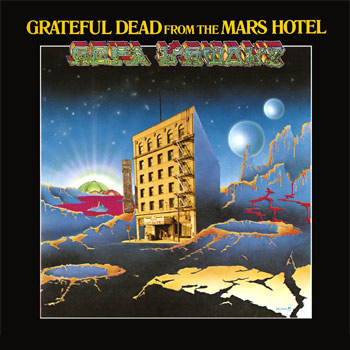
Grateful Dead “From The Mars Hotel”

From The Mars Hotel

For some reason I came late to the Grateful Dead. A perceptive workmate introduced me to Workingman’s Dead and American Beauty in the mid-70’s, and then loaned me this, their latest release, which subsequently became a lifelong favourite.

Now nobody’s ever going to claim this period as the Dead’s golden age. Their collective creativity was heavily diluted by the loss of two original members and a slew of solo and side projects; their organisation was financially mired by its 300-plus employee wagebill, massive organised bootlegging of their first independent release Wake Of The Flood and the spiralling cost of their cocaine habit; and their new fifty-ton PA system, the notorious “Wall Of Sound”, demanded yet further intensification of their already exhausting touring schedule to recoup its outlay. Somehow out of all this they managed to produce in 1974 an immaculate studio album, which despite its quality still remains largely under the critical radar.

The eight songs here all feature taut songwriting and, in contrast with the legendary loose nature of the band’s live shows, gratifyingly tight performances. All would lend themselves to funky stretchout treatment on stage, yet benefitted from the distillation necessary to fit them into a studio collection. Jerry Garcia still finds space to weave his magical, sparkling lines among the verses, and the tight three-man rhythm section (only Bill Kreutzmann on drums here) effortlessly surmounts the exotic, often shifting rhythms. Keith Godchaux provides a new versatility on keys – acoustic piano, synth and harpsichord as well as trademark organ – and his wife Donna gives a new Grace Slick-like edge to the harmonies so saccharine-sweet on American Beauty.

From the opening jaunty shuffle “U.S. Blues”, which captured good-humouredly the cynical yet defensive national attitude following Watergate, to the brooding, diminished-chord-laden Dylanesque closer “Ship Of Fools”, there really are no weak tracks here. For me the standouts include Garcia and Hunter’s oh-so-funky “Loose Lucy” which gallops along on one of Captain Trips’s most irresistable riffs, and Bob Weir’s highly enjoyable reinvention of the old Motown standard “Money” as “Money Money”, in which the avarice is transferred to his unidentified lady friend and the original riff neatly subsumed into a new chord structure and irregular time signature. Phil Lesh finally attains composer recognition with the hazy, shimmering “Unbroken Chain” and the lilting “Pride Of Cucamonga” on which guest pedal steelist, Cactus’s John McFee, provides tremendous accompaniment to Lesh’s earnest tenor. The most gifted singer in the band is of course Garcia, and my personal favourite is his rollicking “Scarlet Begonias” which forefronts the Captain’s delightful plaintive whelp either side of a brief, exemplary Garcia/Godchaux instrumental dialogue, plus some exhilarating Lesh bass on the jazzy coda: definitive 70’s Dead stuff. Oh, yes, and the album title refers to the nickname of an itinerants’ hostel around the corner from the studio.

This album could be the Dead’s best kept secret. Go discover.

“Pride of Cucamonga”

:D CD Reissue | 2006 | Rhino | at amzn ]
:) Vinyl | 1974 | Grateful Dead | at ebay ]

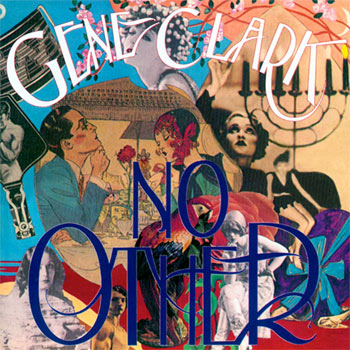
Gene Clark “No Other”

No Other

Barely understood when it was released in 1974, No Other is Gene Clark’s most polarizing record but generally considered essential today. 

Almost every song an epic, Clark’s songwriting was never up for debate, nor his genuinely poetic verses, but it’s Thomas Jefferson Kaye’s production that would weed out hordes of would-be fans. I contend the producer made only one mistake: the use of “power gospel” backing vocals on every track is probably what turns most people off to No Other. Strike the voices and this record would be hailed as a mid-70s masterpiece for Clark’s efforts as much as its lush, candied orchestration. 

The record starts off without skipping a beat from the Clark oeuvre; “Life’s Greatest Fool” sounds like a natural step forward from his earlier country rock. The supporting musicians are perfectly in tune with the vision; I want to dig in deeper with the sound every listen, so I hardly consider it overcooked. One tune does embody Gene’s new super-glam image in sound, where you can “hear the cocaine” churning the record: the sinister title track, “No Other,” is slathered with sleazy synth lines and electric guitars. Whether for camp or pure songcraft it’s an irresistable jam and centerpiece of the record. 

All of the numbers possess the signature Gene Clark sound. Say when he waits for “Strength Of Strings” to reach full crescendo before sinking into his minor-tinged verse with that untouchable heartworn vocal. Clark is one of the world’s greatest songwriters, his skill in transforming traditional progressions to his unique brand of song unmatched.

Give this record the right chance and you’ll reach the point where you appreciate every overdone detail, down to the gorgeous sleeve and awesomely hideous poster of Gene decked in flowing garments, beads, and makeup in front of an airbrushed Gene Clark monument. I only have the record, but the CD resissue is reportedly worth it for the alternative versions and “Train Leaves Here This Morning,” a retake from the Expedition.

“No Other”

:D CD Reissue | 2003 | WEA/Rhino | amazon ]
:) Orig Vinyl | 1974 | Asylum | search ebay ]

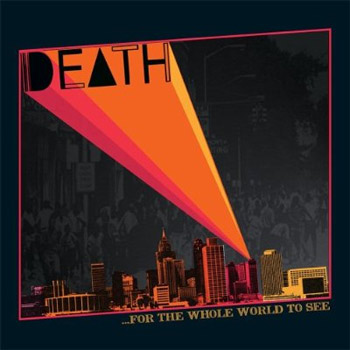
Death “For The Whole World To See”

For The Whole World To See

Death’s 1974 demo album, released for the first time last month on Drag City, is rupturing the walls of the reissue scene, partly due to the recent NY Times article and its aftermath, but mostly for their obvious claim to one of the first slots in the history of punk.

Death was brothers Dannis, Bobby, and David Hackney, who started off playing RnB but switched to aggressive power-pop after witnessing an Alice Cooper show. Their after-school garage practice sessions soon yielded a trio that was tight, ferocious, and way ahead of its time.

The brothers managed to get signed by Groovesville and even got as far as Clive Davis’s interest but refused to change their name from Death for more commercial opportunity. In 1976, after a dissolution with their record company the Hackney brothers pressed 500 copies of their single: “Politicians In My Eyes” b/w “Keep On Knocking,”  reportedly trading  for $800.  Sadly, brother David, the group’s spark and fervent leader passed away in 2000, too soon to get the recognition he knew would one day come.

Bobby Hackney’s sons, members of Rough Francis, are responsible for digging up the old demo tapes that would become For The Whole World To See, and promoting Death’s music in their live performances. This is the kind of recording that’s usually only rumored about, a thing of legends. Listening to unearthed recordings is always magical, but when it’s something as blisteringly hot and grossly unheralded as Death, the experience is flat-out jaw dropping. 

Thanks to all who sent this in. Death’s record is a mind blower on first listen and a clear early contender for reissue of the year.

“Politicians In My Eyes”

:D CD Reissue | 2009 | Drag City | buy from drag city | amazon ]

Double Zappa |FZ| 1974-75

Zappa 1974-1975

After creating his two most commercially successful albums, FZ released a couple of beasts that many progressive fans call his apex and would become the Elements of Style for nearly every jam band in the 90s. I’m more of an early Mothers fan but there’s no denying this is some of his best.

Roxy & Elsewhere (1974)
In the midst of an old Zappa-crazed summer, this one really blew me away. I had never imagined a live band could perform like this, and I still don’t think I’ve ever heard a performance like Roxy ever since. The band was tighter than ever while playing the most complex passages Zappa had yet penned. Pygmy Twylyte and Echidna’s Arf are intricately orchestrated pieces that must have been exhilarating in a live setting. Napoleon Murphy Brock’s vocals balanced the show with a relaxed quality on Village Of The Sun and Son Of Orange County, a mellowed out retake for Frank to stretch his guitar over. The 15+ minute Be-Bop Tango gives a taste of the fun to be had at a Zappa show and a welcome Freak Out! number, Trouble Every Day, offers what may be the heaviest drum fill I’ve ever heard.

“Echidna’s Arf (Of You)”

One Size Fits All (1975)
Same band as on Roxy & Elsewhere hits the studio.  The prog-rock numbers benefit from some studio attention and Ruth Underwood’s tuned percussion feats continue to amaze, but there are some new Zappa classics to fall back on, namely Po-Jama People, San Ber’dino, and Sofa (a recurring FZ theme introduced here in song and illustration). At once, the album will satisfy pop and prog fans alike as things never veer too far in one direction. One Size Fits All is a jewel from Zappa’s prime and never could enough be said of his guitar work on Inca Roads.

“Inca Roads”

Skyhooks “Living In The 70’s”

Living In The 70s

One of the hallmarks of truly great albums is that they document the moment of their creation but sound as though they could have been recorded at any time; they transcend the era of their conception but record it perfectly. Skyhooks’ “Living in the 70’s” is such an album.

Straight ahead rock and roll with an eyeliner of glam, “Living in the 70’s” sheds a small but unblinking light on what it was like to be an inner-suburban post adolescent in Melbourne circa 1974. The opening lines of the album sum it up pretty well. “I feel a little empty, I feel a little strange. Like I’m in a pay-phone, without any change.”

Dislocated, disassociated, dissatisfied and slightly disillusioned, the songs on “Living in the 70’s” touch on the emergence of youth sub-culture that was just gaining a foothold at the time. The children of the sixties were waking up, and for the first time they had the guts not to listen to their parents or authority. It’s not the cry of an anarchist punk, but more the shout of “I’m getting my ear pierced and I don’t care what you say!” by a rebellious teenager. Mild, oh so mild, but still beyond what their parents were capable of. This album helped forge a youthful national identity.

Produced by Ross Wilson (ex Daddy Cool) and put out on the emerging Mushroom records label, the production is clean and crisp and captures the state of the songs much as they were when Skyhooks performed them live. Wilson reportedly fought for production duties on “Living in the 70’s” so that the content was not deliberately watered down to suit the “mature” taste of the times.

Filled with sex, drugs, and rock and roll, six of the ten tracks were banned by the Federation of Australian Commercial Broadcasters, which dictated airplay on the commercial stations, but rather than hinder sales, the attraction of contraband was too hard for the kids to ignore and they sent the album to No. 1 on the Australian charts for 16 weeks.

In retrospect it seems hard to comprehend what all fuss was about, but in the political context of the times songs like “Smut” and “You just like me ‘cos I’m good in bed” were never going to be passed by the censors. The ambiguity that 1974 could give birth to the material, yet try to immediately abort it, was due more to the hangover of 20 consecutive years of conservative Government than anything else, but the country would quickly get over its headache and go in for another round of binge drinking at the party of which “Living in the 70’s” was the soundtrack. An Aussie classic!

“Living In The 70’s”

:D CD Reissue | 2005 | Mushroom | amazon ]
:) Original Vinyl | 1974 | Mushroom | ebay ]

Leonard Cohen “New Skin For The Old Ceremony”

New Skin For The Old Ceremony

In 1974, Leonard Cohen hired producer John Lissauer to help him create the new sound for his songs. Moving away from the heavily reverberating, simplistic arrangements of Songs of Love and Hate (1971), Cohen uses large vocal ensembles, banjos, jews harp, heavy percussion, strings, and woodwinds to create a palate that is, in my opinion, finally equal to the depth of the writing itself.

The album opens with one of my favorite Cohen songs, “Is This What You Wanted.” The record is probably worth its weight in gold for the horn arrangements alone during the first verse (listen, kids, right channel). Once the chorus kicks, with the broken, funky backbeat and the monotone call and response chorus, you know you have stumbled upon something brilliant. Although Rolling Stone called this record “not one of his best,” I feel that it must be considered a classic. Coming in at track 2 is the controversial, beautiful, sex charged new york anthem, Chelsea Hotel #2. One of the few songs Cohen co-wrote, this track details the alleged sexual encounter between our Hero and the one and only Janis Joplin. Songs like “There is a War” bring out the louder, more politically charged side of this artist. While “Who by Fire” is a stunningly beautiful octave charged and simplistic male/female duet which borrows from traditional jewish prayer to ask the question of how will we all die.

Still want to listen? Good. Me too. Full of good funky 70’s folk-rock production with a knack for the depressed and the overly beautiful, this record sings about all the necessary topics you need to get you through the end of march and bursting into the spring. Also, the cover art is so awesome that Columbia refused to press it on the first release of the record. And if Angels want to screw to this music, it can’t be half bad.

“Is This What You Wanted”

:D CD Reissue | 1995 | Sony | mp3 Download | Buy from Amazon ]
:) Original Vinyl | 1974 | Columbia | search ebay ]

Double Zappa |FZ| 1973-74

Over Night Sensation (left) Apostrophe (right)

Throughout the years 1999 to 2003 or so, I collected and devoured just about every official Frank Zappa release. It’s time to let it out of the brain, and hopefully you can use these posts as an introduction to this man’s incredible body of work.

I’ve found that FZ albums tend to come in two’s, so here’s our first double shot of Frank. These years contain his most commercially successful works and act as a fast and bulbous starting point.

Over-Nite Sensation (1973)
Zappa liked a tight band. The players on Over-Nite Sensation (notably featuring George Duke, Ruth Underwood, and the Fowler Brothers) would comprise the cleanest and strictest sounding rock ensemble yet. Nothing shows this more than the insanely detailed changes and synth, horn, and melodic percussion runs to one of my early favorites, Zomby Woof. The gnarly guitar lick and morally condemning lyric to I Am The Slime kinda says it all about his classical/satirical approach to rock music. And the succinct guitar solas throughout this record are both introductions and solid proof of his out-of-this-world modal guitar mastery. Dinah Moe Humm and Montana are bona fide Zappa classics and I remember even steadfast Zappa haters admitted to liking Camarillo Brillo.

“Camarillo Brillo”

:) Vinyl Search | Over Nite Sensation @ eBay ]
:D CD Reissue | 1995 | Over-Nite Sensation ]

Apostrophe (‘) (1974)
Zappa had the extraordinary ability to create unheard new sounds, rhythms, and textures with each of his bands. The opener to Apostrophe, well known favorite Don’t Eat The Yellow Snow, has one of these rare grooves. Turned up loud it’s this killer double guitar riffing that alternates with a fantastic disco hi-hat rhythm. Without changing time signature even, this groove still manages to entrance me today. See, it’s not the goofy, sometimes embarrassing lyrics and jokes tucked away in every Zappa piece that I seek out (though strangely comforting they are); it’s the treasures of complicated movements and studio /conducting genius that made Frank Zappa the transcendental composer and producer we know him as today. Get this one for a perfect development from Over-Nite Sensation, featuring even zanier movements, and of course that sick guitar lick on the title track.

“Don’t Eat The Yellow Snow”

:) Vinyl Search | Apostrophe @ eBay ]
:D CD Reissue | 1995 | Apostrophe (‘) ]

Note: serious fans won’t want to miss the new Classic Albums Series DVD: Apostrophe / Over-Nite Sensation.

(more…)

Simply Saucer “Cyborgs Revisited”

Cyborgs Revisited

Quite simply, this is one of the best proto-punk albums out there. Cyborgs Revisted is equal parts Syd Barrett era Pink Floyd garage psych raunch and early Velvet Underground art-rock sophistication, sounding well ahead of the game and almost too good to be true. It’s a fabulous record that few people have heard, and will appeal to adventurous listeners who are tired of today’s top 40 garbage.

Simply Saucer formed in Hamilton, Canada (Ontario), releasing just one single in 1978 and playing live shows throughout the region. I don’t think Cyborg’s Revisited was officially released during the mid 70’s. I do know that in 1989 an lp version appeared featuring 9 songs. In 2001/2002 a cd version of Cyborg’s revisited was reissued, containing the full album as well as live cuts, their lone single and raw demos. Most of the cuts featured on the 1989 lp (which are the first 9 tracks of the cd) were recorded in 1974. Edgar Breau was the brains behind Simply Saucer writing all the band’s material, singing lead vocals and playing guitar.

Many of these songs are highly experimental within a garage rock format using theremin, audio generators, and other primitive electronics. Electro Rock showcases this experimental aspect of the band with great results and also highlights some exceptional guitar work. Instant Pleasure is a great, brief track as well, with Syd Barrett type vocals and guitar noise mayhem. On Bullet Proof Nothing the band pulls off a great acoustic rocker that sounds like a Lou Reed Loaded era outtake. I can’t see anyone into early Pink Floyd, the Stooges, the Velvet Underground or Can not liking this record.

Simply Saucer has also proven to be influential to popular artists such as the Dream Syndicate’s Steve Wynn who quotes the She’s A Dog 45 as one of his all-time favorites. Other bands of this ilk worth checking out are Debris’, George Brigman, the Electric Eels, the Mirrors, Styrenes, and Rocket From The Tombs.

“Instant Pleasure”

[ Cyborgs Revisited | Search eBay ]

Electric Light Orchestra “Eldorado”

Eldorado

If any album cover has begged/hinted to its listeners to watch the “Wizard of Oz” while listening to the record it’s this one, right? I haven’t done it but I bet it’s awesome. Why? Because anything involving “Eldorado” is awesome. Also check out “The Wizard of Oz”, it’s about this girl who gets caught in a tornado and well I don’t want to spoil the rest…..

Jeff Lynne considers “Eldorado” the first album that accomplished the sound he had set out to make when starting ELO. Some even call it the Sgt. Pepper’s of their career. For me, it’s their best album, if you twist my arm, I might say, “Face the Music” but since you’re not I’m sticking with “Eldorado.” It’s start to finish fantastic, it even has a reprise at the end which always makes us think we’ve come full circle and that we may have missed the bigger picture. It marks the beginning of ELOs string of super albums (Eldorado, Face The Music, New World Record).

“Boy Blue”

Eldorado at Amazon

Electric Light Orchestra - Eldorado